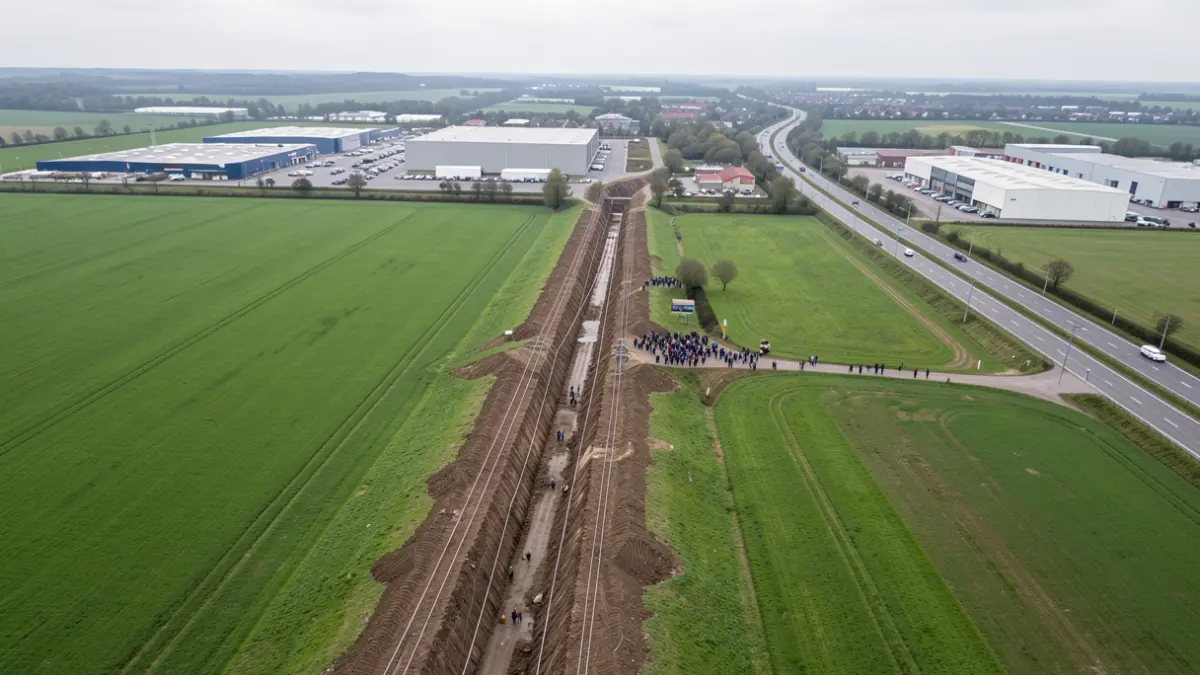
Following the environmental assessment, a new route of approximately 85 kilometers has been identified, extending between the Avelgem and Courcelles substations. This option aims to minimize impacts on the population and environment by concentrating the future line along existing infrastructure such as the A8/E429 highway, the Lille-Brussels TGV line, and the Brussels-Charleroi canal, and passing near 6 business parks. The perimeter affects 14 municipalities: Ath, Braine-le-Comte, Brugelette, Celles, Chièvres, Courcelles, Ecaussinnes, Frasnes-lez-Anvaing, Leuze-en-Hainaut, Manage, Mont-de-l’Enclus, Seneffe, Silly, and Soignies.
The need to strengthen the electrical grid to prevent blackouts, transport renewable energy, and address the saturation of the 150 kV network in Hainaut is confirmed. A hybrid alternating current connection (overhead and partially underground) is deemed the most robust solution, with a fully underground option being ruled out due to network stability and capacity constraints. Undergrounding, which reduces visual impact but requires a significant footprint, will be concentrated where its utility is greatest, particularly in areas of remarkable landscapes, near heritage sites, or residential areas. The goal is to bury at least 8 kilometers.
The Walloon Government has approved the proposal and tasked its administration with drafting a decree project to be submitted for public inquiry in the first half of 2027. Ten conditions will govern ELIA's future decisions, aiming to better protect residents, limit impacts, and ensure fair compensation. These include the voluntary purchase of homes within 100 meters on either side, compensation for those within 200 meters, protection of agricultural operations, maximizing undergrounding, using pylons with high landscape integration quality, funding visual mitigation actions, and contributing to a community fund.