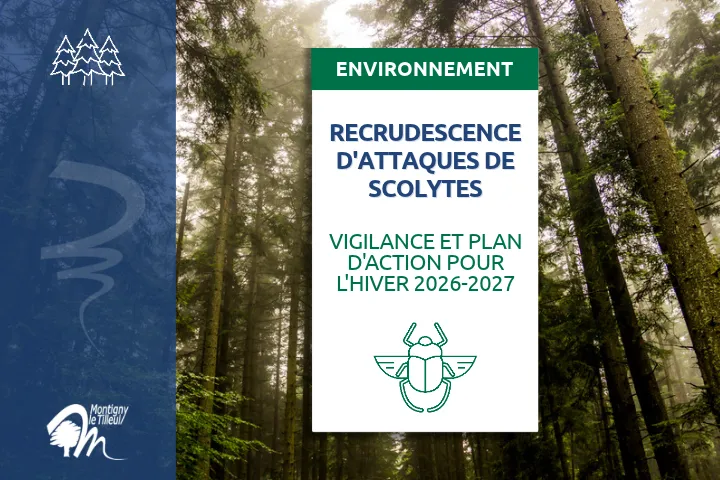
Since late August 2026, forest managers have reported a multiplication of fresh bites on standing spruce trees that appear healthy. This resurgence of activity is observed in several sectors of the Walloon territory. While current data does not allow concluding a generalized crisis equivalent to that experienced between 2018 and 2021, vigilance is required to prevent the development of uncontrolled infestation foci in the communal wooded area.
Adults from this third emergence will spend the winter under the bark of colonized woods or in the leaf litter on the ground, forming an infectious reservoir ready to emerge as soon as temperatures become favorable in spring 2027. Winter sanitary management will therefore have a decisive impact on the health status of the massif.
The municipality has identified three priority intervention axes. First, strengthening field prospecting to identify early warning signals: millimetric penetration holes on the trunk, accumulation of reddish sawdust at the base or in bark folds, and discoloration of the crown (yellowing then browning). Second, systematic exploitation, removal, or debarking of colonized trees. In the absence of immediate removal, debarking logs on site remains the most effective technical solution to dry out the galleries and neutralize larvae.
Finally, strict management of wood deposits and windthrown trees is required. Windthrown trees and un-debarked resinous logs constitute an ideal environment for bark beetle reproduction. All colonized wood, temporary stocks by the track, and windthrown trees must therefore be removed or treated no later than 31 March 2027, a key date before the spring resumption of activity of this beetle.
The municipality invites citizens, potential forest owners, to stay informed via the municipal bulletin. For any methodological support or diagnosis confirmation, they can contact the team at the Walloon Forest Health Observatory directly.