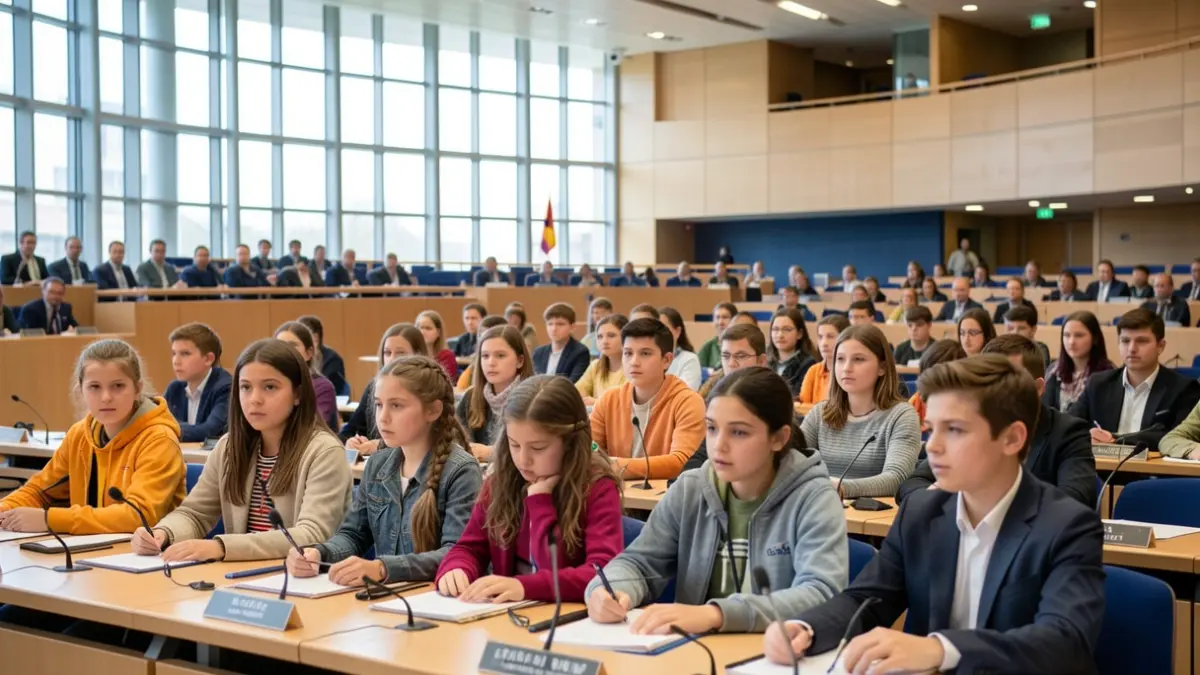
Supported by Europe en Hainaut (France) and the Province of Hainaut through Hainaut Développement (Belgium), these young people were able to take on the role of European deputies after several preparatory sessions. They were introduced to the functioning of Parliament, the role of political groups, the rules of a plenary session, argument preparation, legislative text negotiation, and work.
The simulation particularly focused on cross-border issues, addressing three main themes: territorial development, mobility, and ecological transition. The objective was to help young people concretely understand how European decisions are made and to highlight the importance of dialogue and compromise.
During the morning, the students, divided into different political groups, drafted and negotiated amendments. In the afternoon, they defended their ideas, confronted their opinions, and voted in the hemicycle, guided by Loïc DELHUVENNE, a member of the Team EUROPE DIRECT network.
Concurrently, six young journalists benefited from a guided tour of the European Parliament's press area and received advice for their interviews and reports.
The day featured the presence of several female Members of the European Parliament, including Sophie WILMES (BE), Vice-President of the European Parliament, who opened the proceedings. MEPs Saskia BRICMONT (BE) and Arash SAEIDI (FR) also engaged with the students, bridging the simulation with the reality of parliamentary work.
Participating Belgian schools included Athénée Provincial Jean d’Avesnes in Mons, Institut Provincial La Samaritaine in Montignies S/Sambre, and Académie Provinciale des métiers de Mons. French schools were Lycée de l’Escaut in Valenciennes, Lycée Watteau in Valenciennes, and Lycée Théophile Legrand in Louvroil.